
1. The Problem with Traditional Growth
Scaling a business often reveals a systemic "mess." As companies grow, Marketing, Sales, and Customer Success teams naturally drift into functional silos, each maintaining its own disconnected tech stack, spreadsheets, and processes. This fragmentation forces a reliance on linear growth—a precarious model where you must aggressively increase headcount and investment just to see a marginal increase in revenue.
Revenue Operations (RevOps) serves as the orchestrator and architect of the growth engine. We deconstruct the customer journey to align people, processes, systems, and data, shifting the organization from reactive "data cleaning" to proactive strategic execution. The ultimate mandate of RevOps is to achieve Scale: the pivotal point where revenue growth outpaces investment and headcount growth, fundamentally improving the Lifetime Value to Customer Acquisition Cost (LTV:CAC) ratio.
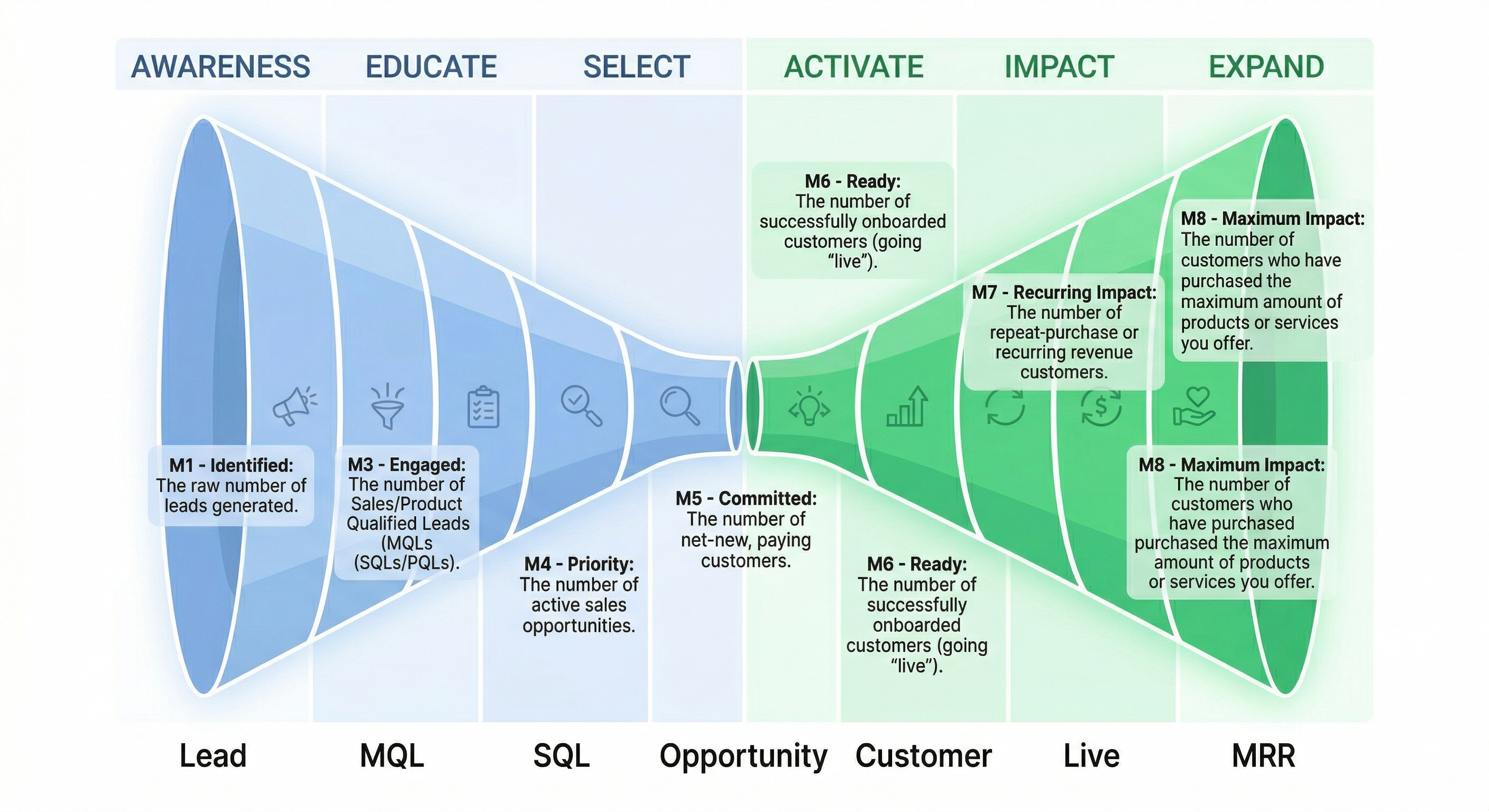
2. The Paradigm Shift: From Funnel to Bowtie
Traditional growth strategies rely on a vertical sales funnel that terminates the moment a deal is signed. This legacy model ignores the most significant revenue potential within a scaling business: the existing customer base.
The Bowtie Model represents a customer-centric paradigm shift. It visualizes the journey horizontally, attaching a mirrored "Expansion Loop" to the right side of the acquisition funnel. We divide this journey into two distinct halves:
- The Left Side (Pre-Acquisition): This focuses on building awareness, educating prospects, and driving net-new conversions.
- The Right Side (Post-Acquisition): This focuses on the "Expansion Loop," prioritizing customer success, activation, and long-term growth through recurring impact.
3. The Four Levers of Revenue Growth
To drive sustainable revenue, a Growth Architect pulls four primary levers. By optimizing these, we increase revenue without necessarily increasing acquisition spend:
- Volume: Increasing the raw number of leads and prospects entering the journey. This lever primarily impacts milestones M1 through M4.
- Conversion: Improving the percentage of individuals moving between stages. This is the ultimate efficiency play, as incremental gains at the top of the funnel have compounding effects downstream.
- Retention: Ensuring customers stay and achieve value. This is measured at milestones M6 and M7 and is the foundation of the expansion loop.
- Deal Size & LTV: Maximizing the monetary value of initial and recurring deals. This lever aligns with M8 (Max Impact), focusing on upselling and cross-selling to capture a customer's full potential.
4. Navigating the Journey: Milestone Metrics (M1-M8)
RevOps utilizes "Volume Metrics" to track the raw number of individuals completing specific actions at eight critical milestones. These are not "feelings"; they are verifiable facts that map the entire customer lifecycle.
|
Milestone |
Name |
Definition |
|
M1 |
Identified |
The total number of leads generated in the database. |
|
M2 |
Interested |
The number of Marketing Qualified Leads (MQLs). |
|
M3 |
Engaged |
The number of Sales Qualified or Product Qualified Leads (SQLs/PQLs). |
|
M4 |
Priority |
The number of active sales opportunities in the pipeline. |
|
M5 |
Committed |
The number of net-new customers acquired. |
|
M6 |
Ready |
The number of successfully onboarded and activated customers. |
|
M7 |
Recurring Impact |
The number of customers making repeat purchases or renewals. |
|
M8 |
Max Impact |
Customers who have purchased the maximum amount of products/services offered. |
5. Measuring Efficiency: Conversion and Velocity
Volume alone is a vanity metric if the engine is leaking. We measure the health of the machine through Conversion Metrics (CR) and Time/Delta Metrics (∆t).
- Conversion Rates: We track the percentage of people transitioning between stages. Low conversion identifies specific bottlenecks (e.g., a low CR3-to-CR4 transition suggests a breakdown between lead qualification and opportunity creation).
- Decay Rates: These identify the point of diminishing returns. For example, if data reveals that MQLs rarely convert after day five, but your sales team continues outreach until day ten, they are wasting 50% of their effort. By halting outreach at the "decay point," you allow reps to refocus on fresh leads—increasing revenue by as much as 33% without spending an extra dollar on acquisition.
- Delta/Time Metrics (∆t): We track the "velocity" of the pipeline using specific metrics:
- ∆t4 (Opportunity time-to-close): The length of the sales cycle.
- ∆t5 (Time-to-onboard): How quickly a committed customer reaches the "Ready" stage.
6. Operationalizing the Model: Two Practical Starting Points
To move from theory to execution, I recommend two foundational frameworks that drive immediate alignment.
The Sales and Marketing SLA
A Service-Level Agreement (SLA) is a two-way contract. Marketing promises a specific value of leads, and Sales promises a follow-up timeframe (typically 24 hours).
Advanced Strategists move beyond raw lead counts to Lead Value Quotas. By multiplying the conversion rate of a specific lead bucket (e.g., "hand-raisers") by the average sale value, Marketing is assigned a dollar-value quota (e.g., delivering $100,000 of lead value per month). To ensure accountability, we establish a "Judicial Branch"—led by an unbiased executive like a COO or CEO—to review uncontacted leads and verify qualification quality.
Trimming the Sales Process
We optimize the sales pipeline by evaluating every step against three strict pillars. If a step fails any of these, it is friction and must be removed:
- Required: The step must be intended to happen in every single sale, without exception.
- Factual: The step is tied to an objective action (e.g., "Prospect attends demo") rather than a feeling (e.g., "Prospect likes the product").
- Inspectable: The step must be explicitly verifiable via a record in the CRM.
Critically, we align every Seller Action with a corresponding Buyer Action. The Buyer Action serves as the Exit Criteria; a deal cannot officially advance to the next stage until the buyer has completed their required action. This ensures the pipeline is rooted in buyer reality, not seller optimism.
7. Conclusion: Velocity over Speed
In Revenue Operations, we distinguish between Speed and Velocity. Consider a bicycle: if you pedal furiously in first gear, you have high speed (effort) but low traction. If you shift to a higher gear, you may pedal slower, but each rotation provides more thrust and moves you further. This is velocity.
RevOps is a mindset of professional problem-solving and empathy. We don't just "fix systems"; we work in the background to eliminate friction for the front line, building a growth machine that runs predictably and efficiently.
Your first step as a strategist is to audit your own "forces and frictions" through the Bowtie lens. Where is your revenue leaking, and which lever will you pull first to plug it?